Friday, July 20, 2007

Civilian Casualties Wiki Tries To Document Afghan War


You should go...

While browsing Wikipedia I found a wiki dedicated to tracking civilian deaths in the war in Afghanistan.

As well, I thought a little history of the Soviet war in Afghanistan (1979 - 1989) might be an interesting read, it sums up with a familiar polemic...

“..the Soviet war in Afghanistan has often been referred to as the equivalent of the United States' Vietnam War.”


So now, the cold war is over, and Afghanistan is the United States' Vietnam again... (with Iraq, the evil twin).


However much things change, sometimes they seem to
stay just the same.


mh

Thursday, July 19, 2007

A Surge In Afghanistan? -- It May Already Be Too Late

On Wednesday July 18, '07 a British Parliamentary Committee report on the war in Afghanistan was released; it is full of bad news, and some inane talking points...

The Associated Press wrote a story carried in the International Herald Tribune entitled, "NATO's Force In Afghanistan Is Being Undermined, UK Panel Warns",

"The NATO mission in Afghanistan is being undermined by its members' failure to provide adequate troops and serious strategic mistakes, a British parliamentary committee said in a report Wednesday.

Echoing concerns expressed by senior British military figures in recent weeks, the legislators warned that the entire Afghan campaign is at risk if leading NATO countries continue to refuse to deploy additional personnel.

Lawmakers also criticized the pace of work to combat the opium trade in Afghanistan and said NATO was failing to communicate its successes to ordinary Afghans, handing the propaganda initiative to the Taliban."

(continue)


The 'serious strategic mistakes' referred to above, is talking about the three major coalition entities working at cross purposes. With-in the nexus of these, NATO (with three different sets of engagement rules), Enduring Freedom (US Air Power and special forces), and the Agency Coordinating Body for Afghan Relief or ACBAR (relief groups) are the horrific, and unprecedented civilian death rates, the lack of coordination and investment in rebuilding and security, and the lack of a central military command. (!?)

The Guardian Unlimited weekend edition, The Observer, ran a piece by Nicholas Watt and Ned Temko last Sunday, July 15, '07. From interviews with Lord Ashdown, a career diplomat and politician, and Lord Inge, former chief of the defence staff, Watt and Temko out-line the British defence staff's opinion of the state of the war in Afghanistan:

(my emphasis)

"Inge's remarks reflect the fears of serving generals that the government is so overwhelmed by Iraq that it is in danger of losing sight of the threat of failure in Afghanistan. One source, who is familiar with the fears of the senior officers, told The Observer: 'If you talk privately to the generals they are very very worried. You heard it in Inge's speech. Inge said we are failing and remember Inge speaks for the generals.'

Inge made a point in the Lords of endorsing a speech by Lord Ashdown, the former Liberal Democrat leader, who painted a bleak picture during the debate. Ashdown told The Observer that Afghanistan presented a graver threat than Iraq.

'The consequences of failure in Afghanistan are far greater than in Iraq,' he said. 'If we fail in Afghanistan then Pakistan goes down. The security problems for Britain would be massively multiplied. I think you could not then stop a widening regional war that would start off in warlordism but it would become essentially a war in the end between Sunni and Shia right across the Middle East.'

'Mao Zedong used to refer to the First and Second World Wars as the European civil wars. You can have a regional civil war. That is what you might begin to see. It will be catastrophic for Nato. The damage done to Nato in Afghanistan would be as great as the damage done to the UN in Bosnia. That could have a severe impact on the Atlantic relationship and maybe even damage the American security guarantee for Europe.'

Ashdown said two mistakes were being made: a lack of a co-ordinated military command because of the multinational 'hearts and minds' Nato campaign and the US-led Operation Enduring Freedom offensive campaign against the Taliban. There was also insufficient civic support on, for example, providing clean water.

Ashdown warned: 'Unless we put this right, unless we have a unitary system of command, we are going to lose. The battle for this is the battle of public opinion. The polls are slipping. Once they go on the slide it is almost impossible to win it back. You can only do it with the support of the local population
."

(continue)


To me, it doesn't seem that the message being sent by the military leaders to the politico's has gotten though. The Parliamentary Panel's high-lighting of the heroin issue shows a cultural myopia and a miss-understanding of the war that may actually speed the disillusionment of the Afghan population with NATO.

If we wish to see this through, we need an Afghan Surge, a spreading area of operations that
constantly establishes new 'forward operating bases' in each capital, in each town until every crossroads has a federal and/or local police presence. At The Same Time, irrigation and electrical infrastructure projects, and training on all levels must move ahead. NATO/ACBAR need to be paying farmers to work at improving the value of their land.

More than 33,000 western soldiers are in Afghanistan now. It's going to take perhaps 100,000 soldiers, plus twice as many civil engineers, planners, police, training not to mention MONEY.

This needs to be approached with the same sense of import as the reconstruction of Europe after WWll. This will be harder though, 20 years of war rather than 5, and a level of infrastructure and education levels that are behind by a century.

OR...

Negotiate with the Taleban, and get out as soon as possible. Offer the Taleban a share of government in exchange for a guarantee Afghanistan would not tolerate foreign extremists (Al Qaeda). It's an olive branch the Taleban have extended on several occasions; most recently when they made the statement that they had nothing to do with the 'new' suicide tactics in the
summer 2006. It will mean we have to tolerate another Iran -- a new Islamic state in the region -- in exchange for regional stability.

I think it's a good deal.

The buffoons in political office through-out NATO seem to think 2,000 more troops and few more helicopters will rescue victory from the jaws of defeat.

What the generals are saying -- I think -- is that we may wake up some morning soon, and be shocked to discover that over night, the Canadians
at Kandahar have been over run.

Canadians need to press government for clarity here, what will it actually take to win this war? Not one more drop of blood is worth it if this continues as an escalating series of civilian horrors.


FilterBlogs Afghanistan label.


mh

Friday, July 6, 2007

A Bad Day, Early In July...

Captain Jefferson Francis, Captain Matthew Dawe, Master Cpl. Colin Bason, Cpl. Cole Bartsch, Cpl. Jordan Anderson and Pte. Lane Watkins were killed in a IED attack upon their armored personnel carrier, on 04 July 2007.

I grieve for the lost of Canadian soldiers and offer my sincere condolences to their families and friends.


Afghan President Hamid Karzai last week echoed the release of an ACBAR report on civilian casualties in this war. The ratio of civilian to combatant deaths is around 1 to 1; meaning that as many Taleban and Nato forces have died as innocent civilians.

As a result of nine deaths in two separate IED attacks on Canadian Forces in the last three weeks, the conversation on the home front has come down to "we need safer transport" More highly armed personnel carriers is a good idea, yet it will only skew that terrible ratio for the worse -- and will be countered by the Tabeban, in time, with better more powerful IED's.

Can we buy piece of mind? This discussion about 'safety' in a war is ridiculous, in my opinion.


The Associated Press published a piece, picked up by The Independent, that has a good over-view of what the last few weeks has been like for Canadian Forces in Afghanistan.

"Southern Afghanistan has seen fierce fighting in recent weeks. More than 2,900 people - mostly militants - have been killed in insurgency-related violence in Afghanistan this year, according to an Associated Press tally of numbers provided by Western and Afghan officials.

Of the 102 foreign soldiers killed in Afghanistan this year, 46 were Americans, 18 Britons and 22 Canadians.

Also in the south, militants battled Afghan and US-led coalition troops in separate clashes that left 20 militants and one policeman dead, officials said.

Militants attacked at least three police checkpoints in Ghazni province on Tuesday, and ensuing gun battles left 13 militants and one officer dead, said. General Ali Shah Ahmadzai, the provincial police chief.

In Zabul province, Afghan and US-led coalition forces clashed with suspected Taliban militants on Tuesday in Shahjoy district, leaving seven militants dead and six others wounded, said Ali Kheil, a spokesman for the province's governor."

We lost another battle last week, 45 civilian dead, 20 Tabeban -- in one incident -- from Yahoo! News.


ACBAR is the Non-Governmental Organization (NGO) umbrella group; all the non government players active in re-building infrastructure, in-country.

List of the dead from CBC


mh

Wednesday, June 27, 2007

UPDATED: CIA's "Family Jewels" Raise Concerns About Civil Liberties

Today's release of some, still censored CIA illegal operations, began a discussion on NPR's radio show "To the Point", with Warren Olney, about current tactics in the Global War on Terror.

The web site frames the discussion like this:

The CIA has released "the Family Jewels," agents' reports on 25 years of illegal activities ending in 1974. CIA Director, General Michael Hayden, says it reveals "a very different time and a very different agency." How different is the CIA now, with Dick Cheney holding the intelligence portfolio for President Bush?

The podcast of the episode.

These revelations come as Vice President Dick Cheney's Office is coming under increasing scrutiny by law makers.

Never in history has the office of the vice president been so large. Conventionally, the office was seen as that of an 'apprentice', an 'observer', ready to fill the void should the president become un-able to execute the office.

Now it seems to be a clearing house for black operations, a way to compartmentalize, isolate the office of the president from illegal activities which the president could be impeached for under law passed in the wake of the Watergate scandal.

From USA Today:

Rep. Rahm Emanuel of Illinois, chairman of the House Democratic Caucus, said Sunday that a court should decide whether the vice president belongs to the executive or legislative branch. "The vice president needs to make a decision," he said.

Lea Anne McBride, a Cheney spokeswoman, said Emanuel is the one who has to decide. "He can either deal with the serious issues facing our country or create more partisan politics," she said.

The Empirists are saying, this is like WW ll, the state requires special powers to fight The Global War on Terror. They're objective would appear to be the repeal of the 'Watergate' laws.


mh

Saturday, June 23, 2007

Essentially, Lieutenant-Colonel Rob Walker Is Lying By Omission.

In my last post on the War in Afghanistan I tried to give a broad picture of the Taleban offensive and NATO's reaction to it.

Now, a little more detail on the Kind of war Canadian soldiers are fighting.

(Here's some music to listen to while reading THIS article.)

I came across this quote from Lieutenant-Colonel Rob Walker, battle group commander for the Canadian contingent in Afghanistan, in the Saturday June 23, 2007 edition of the Globe and Mail in a story by Graeme Smith entitled, "Afghan Civilian Casualties Soaring":

“We're being very judicious about our fire,” Col. Walker said. “We've had no complaints about women and children getting killed.”

That's horse sh*t.

When Canadian Forces find Taleban dug in, they call in air support from 'Enduring Freedom', the US operation in Afghanistan, who then - guided by lasers pointed by Canadians - blow the target to smithereens.

Essentially, Lieutenant-Colonel Rob Walker is lying by omission.

(WARNING: the following contains horrific detail.)

After the bombs hit, our boys don't experience that disingenuous tripe; instead they get reality. They go in and reconnoiter the target - to see how many Taleban bodies they can identify - and in some cases, they get to count dismembered corpses of babies, women and old men.

And then they get to puke.

One of the most awful descriptions of the casualties I've heard of in this new era of high energy explosives comes from Iraq...

You get to the target, and there's movement in the smoke, 'things' are moving in there - then you realize it's people, live people - with no arms or legs, in shock - they're trying to move, trying to get away... get to safety.

Our young men are now faced with a moral dilemma (if there's no superior officer present), shoot them in the head to put them out of their misery; or try to tourniquet the stubs (which, when you try, just breaks the burnt skin and makes the wound worse); or do you continue about your duties, secure the area etc., while the bodies continue to scream, writhe, and finally die.

A third option, give the one screaming the loudest, the heroin in your med kit (which is against regulation, but you can replace it easily enough).


Here's another example of spin doctoring from the battle group commander of Canadian Forces in Afghanistan; from a June 14, 2007 Globe and Mail story by Graeme Smith. (now, only available with a subscription from Canada's National, Profiting from Death, Newspaper.)

"Pressure from NATO forces has so far prevented the Taliban from forming into large attack groups of the kind witnessed last year", Lt.-Col. Walker said..
That's horse sh*t too.

The tanks we shipped over there last year... ..that has nothing to do with the Talebans changed tactics this year... ..like we should all feel better knowing we fought them to a stand-off LAST year.

While we're at it, if we're talking about the 'last war', why not mention how surprised we were when they used regular tactics, the failure in our intelligence, that gave us no clue that they were capable of that level of organization.

Don't try to bull sh*t the Canadian people, Lieutenant-Colonel Rob Walker, Canadians may be a few days behind the news, but we're not stupid - or ignorant.

Why is the battle group commander running psychological operations any way? Does DND not have a communication department in country?

Man, we look provincial.


In other developments, CTV reported that,

"..NDP Leader Jack Layton said Canada should stop aggressive military action in the war-torn country and move towards political negotiations."

Agreed, but we should be in constant negotiation with the enemy, even if we decide that continuing aggressive military action is in our interest.


mh

Wednesday, June 20, 2007

More Lost Battles In Afghanistan - The Forgotten War

In my last post on the Taleban offensive in Afghanistan, I supposed Canadian Forces were likely in the thick of it.

They are.

On Wednesday, three Canadian soldiers died on the road near Masum Gar, Afghanistan.

Written by Stephanie Levitz, Canadian Press @ Canada.com

"The blast killed all three soldiers in the vehicle while they were carrying out a resupply operation near a forward-operating base at Sperwan Ghar, the military said."


And later in the same story...

"The latest deaths came on the day of the military funeral for 25-year-old Trooper Darryl Caswell in Bowmanville, Ontario. He was also killed by a roadside bomb on June 11, when the Canadian military in Afghanistan came across a large number of improvised explosive devices."

The national media is
presently reticent to offer an over-view, from scant reports, about what's going on in this forgotten war. I am not as reticent as they, but I understand their point. Writing war is full of land mines; what you think is going on, is probably wrong. If your facts are straight, the story may not be temporal.

Luckily, I am not beholden to anyone at this blog, only the attentions of you readers. So, here are a collection of my 'temporal slices' from this forgotten war.


The new British ambassador to Afghanistan, in his first statement in his present capacity expressed either the level of his ignorance, or the height of his arrogance...

(quoted from an article in The Independent, June 20, 2007, by James Tapsfield, my emphasis)

Ambassador, Sir Sherard Cowper-Coles:

"The great(?!) thing about the Taliban is that they haven't been reading their Chairman Mao. They don't have popular support."

The Taleban are not disciples of the idea of populism like the communist movement
(which champion the majority, peasants or workers), that the ambassador refers to.

Taleban don't care if they have popular support; in 'imperially occupied territories', they create a tension of insecurity, going as far as butchering citizens they deem un-Islamic. On this Podcast from The Guardian Unlimited "..Declan Walsh reports on how locals are resisting this Talibanisation. Also, see an informative audio slide show, historical backgrounder, from the Guardian Unlimited.

The Taleban exude purposefulness and discipline; and they demand popular obedience, not support. They are the products of a sect of fundamentalist Islam's, 'madrassa', schooling. They are the elite of a education system that teaches extreme intolerance and armed insurrection towards an Islamic state. They insist on an extreme standard of public decorum in the areas they dominate. Disobedience is rewarded with brutal public sanction, including death.

The population is suffering under the Tabeban's Islamic law, murder-squads, and a NATO war machine that is unbelievably powerful, destructive, and indiscriminate. The Taleban draw their enemy to fight in populated areas because towns are the fulcrum of government power; and it is to their strategic advantage. Regularly, a village will become a free fire zone, a rule of engagement I've heard interpreted as, 'shoot anything that moves' orders. And they do.

Published in the New York Times Barry Bearak and Taimoor Shah wrote,

KABUL, Afghanistan, June 18, 2007

Afghan officials said late Monday that more than 50 civilians may have died during fierce fighting over the past three days between NATO forces and the Taliban in the Chora district of the southern province of Uruzgan.
Lost that battle.

That's Canada's bailiwick. No reports yet as to which NATO force was involved.

Maj. Dave Quick, commanding officer of India Company, Royal Canadian Regiment, told Stephanie Levitz,
"..Wednesday's (June 20, 2007) battle was longest firefight his company has been in even though it was their 12th combat mission in the last month."

On Thursday Canadian troops were involved in another action in Helmand province.

By Peter Walker of The Guardian
"The air strike - which happened late yesterday (June 21, 2007) - was launched in response to an attack on police posts near the town of Gereshk by militants. It killed 25 civilians including nine women, three babies and the mullah of a local mosque."

Lost that battle.

Later in the same story Peter Walker writes.

According to the Associated Press news agency, the latest deaths - if confirmed - will bring the number of civilians killed in NATO or US-led military operations this year to 177. Among these were seven children who died in a US air strike on Sunday.

A total of 169 civilians have been killed in militant attacks this year, including a recent series of suicide bombings.

So between us and them are 346 civilian dead.


"The latest NATO deaths bring to 606 the number of foreign troops killed in action in Afghanistan since the overthrow of the Taleban in 2001."(from © Reuters 2007)

Sixty Canadians serving in the Canadian Forces and one diplomat have died in Afghanistan so far.

I hope this over-view gives Canadians an idea of the intensity of action our soldiers are facing right now.

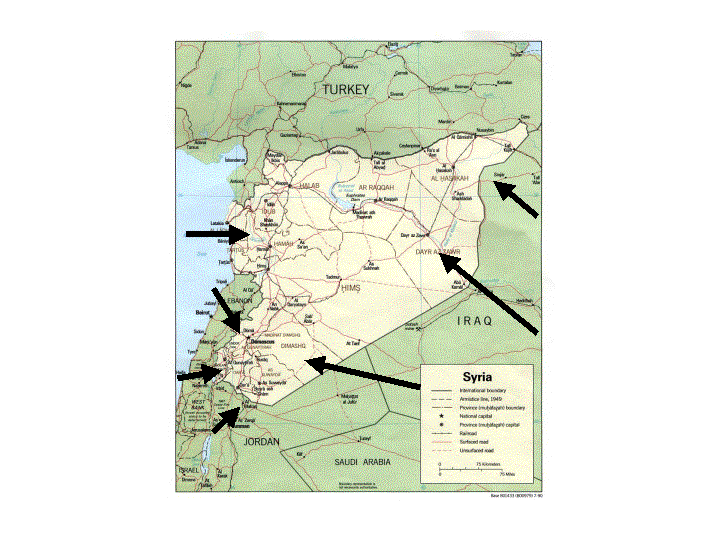
Map courtesy of University of Texas, Perry-CastaƱeda Library Map Collection

Agency Coordinating Body for Afghan Relief (ACBAR) press release: "Protecting Afghan civilians: Statement on the conduct of military operations."


mh

Tuesday, June 19, 2007

"Invite The Taleban To Join A Broad-Based National Government In Afghanistan"

The Taleban are taking the war to us, as expected. Right now in Afghanistan, Canadians are likely in the thick of it, marshaling in response to a multi pronged offensive by the Taleban. The Taleban's tactical plan for this year is to attack closer and closer to the capital, while simultaneously attacking strong points everywhere -- towards toppling the government.

"What did he say???"

That's right folks, that's where we are, that's the topic list.

The Taleban are attacking towns as close as 150 miles from Kabul. No road is 'safe' as police stations all over the country are being attacked; forcing the NATO war colossus to operate in a complex, multi faceted manner -- testing the limits of it's advantage.

We have lost the hearts and minds of Afghans by now, I fear. If this continues into the summer, then the war is over -- time to pack up and leave.

June 19, 2007 -- BBC NEWS,

By BBC World Affairs editor, John Simpson

In the east of the country, around Jalalabad, suicide bombings have become such frequent occurrences that the road from there to Kabul is now known as "the Baghdad road".


In the far western, Herat Province, May 31, 2007 BBC NEWS,

By Alastair Leithead

He described how it was only after the villagers were angered by culturally insensitive house searches that they picked up guns and took on the American military machine.

"When the Americans came the people started fighting them back, and then the planes came and started bombing us. "Even under the Russians we haven't witnessed bombardments like it before."

The Afghan Independent Human Rights Commission (AIHRC) investigated the accounts and identified that at least 25 of those killed in Shindand were women and children.

Lost that battle.

In the following, the mans question gets to the point - the battle is not to beat the Taleban with military might, it can't be done, but rather to win the hearts and minds of Afghans.

From BBC NEWS story, "Afghan villagers answer your questions"
(My emphasis)

QUESTION: from Farid Mamundzay, Birmingham, UK,

It is often argued that Afghanistan was peaceful during the Taleban rule, and that after their fall, the country has not enjoyed the same level of peace and stability. Do you agree? Do you see the presence of foreign forces important for the future of Afghanistan or should the Taleban be invited to participate in a broad national government?

ANSWER: from,
Rahmat Gul:

You are partly right. People did enjoy peace and stability. But Taleban laws were harsh and draconian. Now the laws are within the framework of a democracy and if we implement them we could have more peace and security.

To your second question - I think foreign forces should coordinate their operations with Afghan forces in a bigger way to avoid civilian casualties.

The thing is that if you invite the Taleban to join a broad-based national government, there will be no need for foreign troops in the country at all. It would not be such a bad idea, though I wonder how the Taleban would react to such a proposal.

It would be a good idea to declare an amnesty for all the indigenous Taleban and bring them into the mainstream of politics. The foreign Taleban should be kept out.

Invite the Taleban to join a broad-based national government, in exchange, NATO could leave. I wonder how the Taleban would react to such a proposal. As we see in Gaza, the fundamentalists don't play well with others... The other choice, for both sides, is endless this.

Building schools has failed I believe, because the tactic falls directly into the scope of the most effective of Taleban tactics -- playing to the fears of men and boys, who's identity is already in an abused state, now challenged by a liberating of women in the law -- while their identifier, farming, remains impossible because irrigation projects 1000's of years in use, remain destroyed from thirty years of war.

Rebuilding and improving the irrigation infrastructure, would employ farmers in their own self interest.
They gain back identity in providing for their families, and the Taleban lose a fighter -- progress then would then surely follow.

Irrigation Infrastructure should be the the focus of a re-newed attempt, that is coming soon, to re-build infrastructure. Essential, culturally based infrastructure like the irrigation system --would help Afghans live day to day, and at the same time employ would be fighters at farming, and thus empower the family and local authority against the Taleban.

Information in the form of high quality color coded topographical mapping, and meteorological information would be a great way to interlock with the local economy -- and later as security returns, help NATO influence WHAT is grown with the water.

I fear these are but lost opportunities in the this, other imperial blunder. We have lost so many battles for minds in Afghanistan, and our tactics remain intractable -- that we are now losing this war.


mh

Friday, February 23, 2007

For What It's Worth, A Take From Baghdad

The following from RiverBend; a blog by an Iraqi Citizen living in Baghdad.(link in Title of posts)

"The Americans have done a fine job of working to break it(Iraq) apart. This last year has nearly everyone convinced that that was the plan right from the start. There were too many blunders for them to actually have been, simply, blunders. The 'mistakes' were too catastrophic. The people the Bush administration chose to support and promote were openly and publicly terrible- from the conman and embezzler Chalabi, to the terrorist Jaffari, to the militia man Maliki. The decisions, like disbanding the Iraqi army, abolishing the original constitution, and allowing militias to take over Iraqi security were too damaging to be anything but intentional."

I've seen bigger 'mistakes' executed in war. Myopic blunders in war become catastrophes on the ground very quickly.

On the other hand a Strategy of Tensions designed towards a larger war that the US Army could win is not a new idea.

For what it's worth, that's a take from Baghdad.


mh

Wednesday, January 17, 2007

Iran Shoots Down US Spy Plane

For what it's worth, a take from Terhan...

FARS News agency(IRAN)
TEHRAN (Fars News Agency)- Iranian military troops have shot down a spy plane of the US army during the last few days, an Iranian MP said here on Tuesday.


Bush end game?


mh

Wednesday, December 27, 2006

How Did We Get Here? An Analysis

Canadian soldier at Kandahar


That is not my oil, that is not my beautiful car.

Originally published September 4, 2006

Canadian soldiers are now involved in a NATO counter insurgency in Afghanistan. This summer, for the first time since Korea we saw Canadian soldiers in a fire-fight. How did we get here?


Well, 9/11 happened - Al-Qaeda was blamed. The government of Afghanistan, the Taliban, aided and abetted them. On October 7 the area bombing of Taliban strong-holds began. The Americans supported one of several groups fighting in parts of Afghanistan. The Northern Alliance and others formed a provisional government on April 18, 2002; officially ousting the Taliban; and institutionalizing US primacy in Central Asia.

Canadian troops were sent by the Liberal government of Jean Chretien in 2002; to fill a power vacuum created by US bombing, and to rebuild the country after 10 years of Soviet occupation and 10 more years of civil war.

Four years later the Taliban have regrouped. What we are doing there now, in no way resembles peace keeping or reconstruction. Canadian soldiers are involved in a NATO counter insurgency. Its time to take stock.

How did we get here, why are we trying to kill them? Oh yes.., 'the Taliban aided and abetted Al-Qaeda'.

The Taliban are no friends to democracy, rule of law, the enlightenment, or equal rights. They desire a theocracy like the Dark Ages(400 - 1600AD) - when Rome projected terror across Europe to maintain its' primacy - not anything like the German Fascism of the 1930's and '40's the Whitehouse keeps pumping. Neither are they friends of an oil pipeline on the northern border. A pipeline that would send regional resources west, to the USA; or the 'Great Satan', in their vernacular.

I personally wouldn't support a government like that; but that doesn't mean I would go to war with them either.

The Taliban stopped the opium crop when they were in power, something we cannot seem to do. The Taliban have never invaded a foreign land; they are not even a regional power. At this time, a multi-polar global power negotiation is in progress; Taliban rule, while hard to stomach could be a stabilizing force right now. The alternative, an unwinnable urban war could become much worse.

Tolerating the DE-facto situation in Afghanistan is not defeat, its clear thinking. Canada, as a member NORAD and a transmogrified NATO should push for another way.

We could have cut a deal with the Taliban in 2001; we may need to now. Before more blood is spilt, NATO's political leaders should talk with the Taliban who controlled 90% of the country pre-9/11.

A US 'No Fly Zone' would project Imperial tranquility with-in a schematic borrowed from British imperial history; a step 'back to the future', towards the G-8 model of the balance of powers pre 9/11. To facilitate this the Americans have to recognise Russian control of her oil industry; just as congress blocked China from buying UNICOL the largest energy company in the world(US), the Russians are protecting their national interest, albeit with slight of hand and 'lawyering'.


A 'No Fly Zone' would facilitate an intelligence net and the ability for the US to project influence on the Taliban government; and to maintain their primacy with-out Al Qaeda or other forces. It would continue to fortify and stabilize the Northern Alliance, and with Russian help, ensure passivity along the northern border; bringing relative stability to the entire region.

We need to deal. The question is, do the Taliban still want to make a deal, now that they have us perplexed militarily? The road out will hurt more than the road in; but less than an unending counter-insurgency amongst an increasingly desperate civilian population.

We have to make a deal. With in a model that recognizes American primacy we can propose: give the Taliban power with-in a new US hegemony that recognizes the strategic importance of the northern frontier and the impropriety of tolerating Al Qaeda's presence. This would serve all the demands of Bush's' 'war on terrorism' and the underlying strategic objective: an stable oil pipe-line corridor to Turkey.

One problem with this plan is that the Northern Alliance and the Taliban were at war pre 9/11. The Taliban may have been involved in the assassination of the Alliances top field commander, Ahmed Shah Masood. But the reality of the situation is that they would have no choice but to accept the power. Undoubtedly they would display a genuine front while perusing other agenda. This is standard when empires try to project their will.

All this speaks to the complex inter-dependencies present, in the largest Geo-political sense. Canada with its vast oil
and gas reserves, has very little interest in any of these machinations, aside from one.

We need another assembly line at the Oakville Car Plant. In jest of coarse, but it represents a critical part of our Strategic National Interest. The basis of the post war affluence in Canada was the Auto-Pact. Canada traded leading Jet technology and expertise to the Americans for a share in the American automobile market and other things. This guaranteed Canada's post war affluence; and Americas primacy in air power and space power.

If we continued the "head in the sand", Jean Chretien strategy of doing as little as possible while continually telling the Americans they're too loud, the USA might restrict trade with-in a post 9/11 xenophobic reaction.

American protectionism is not on the political front burner right now in Washington, instead it's been over shadowed by a ugly drift towards persecution of non-citizens, witnessed by the massive Latino demonstrations around the still stalled immigration bill. Illuminating just how important citizenship has become to protecting ones self from both real and perceived new anti-terrorism powers of the state.

60% of Americans polled think their army should be out of the Iraq debacle. They can hardly be vitriolic now if we suggest a different coarse. In fact we might be their best friends again by 2008. We should lead and innovate now, be the honest broker.

This congressional election year, the Whitehouse is easing up on the rhetoric and is trying to look more conciliatory. Surrounded by litigation and corruption scandals all around, and a quagmire in Iraq, the administration might be willing to talk.

Lets make a deal!


mh

Saturday, November 11, 2006

Hill 145 & The Pimple

Originally published 11/11/06; Updated, 04/09/07, with new links!


General Arthur Currie

After 3 years of carnage, where the life-blood of entire generations from four continents was left in the soil of Europe, someone on the front lines was given real power to realize a plan that hopefully would see the Allies out of four years of senseless death. That person was Canadian General Arthur Currie and his plan was one the first sign of no front warfare.

(with help from: senior commander, Field marshal, Douglas Haig and Field Marshal Third Army, Julian Byng. It is important to note that after this battle Currie took over Byng's job, as Byng was shuffled up the ladder of success. Currie was the first Canadian Commander of the Canadian Corps.)


Curries plan was the logical progression of the ever increasing complexity of modern war but most inportantly a recognition of how artillary and machine gun had forced tactics to change.

'The Pimple' is the name given to the high ground upon which the German artillery dominants the great plain around Passchendaele just beyond Ypres. Hill 145, just to south, and in range of the Pimple, must be taken at the same time.

The soldiers who would be going over the top were informed of the details of the attsck and trained for weeks. On actual sized layouts of enemy positions, drawn on the ground from maps drawn by special forces and aircraft photography. A new tactic soildiers really liked, was going over the top in small lines, in sections, rather than as a line to be cut down like wheat to a silth of machine gun fire. They trained to walk slowly at an even pace under fire. For as they walked out into no mans land the morning of the attack, behind them, the guns would be sounding and in front of them a curtain of death,artillery, softening up the enemy and cutting. The Canadians were to walk calmly into this hell pacing like the zombees in 'Night of the Living Dead'.

By the end of the day, special forces on both hills are successful - but with horrendous loses (compaired with modern tactics) - and Canadians hold both hills. The fast pre-planned advance through the centre begins. Now the giant machine, Nye a CITY, the size of present day Vancouver, lurches to life, a collasal juergauraut. Forward, to exploit the opening, it moves 4.5 miles the first day, the largest single advance by either side since the first summer, 1914.

It was a template of war to come; at the end of this war, that was to ended by mutual exhaustion, rather than by victory by an army.

Currie created a mammoth information gathering and dissemination system, and supply infrastructure that looked like a modern government bureaucracy. Planners integrated real-time statistical information into battle plan. Like a coiled steel snake about to strike, it was designed to move quickly and powerfully in a synchronised fashion. It was designed not only to win battles but exploit them with powerful, rapid advances. This was one of the first successful examples of what later became known as Combined Operations.

Currie probably borrowed from Field Marshal Alfred Graf von Schlieffen; who's battle plan was the opening act of this war. More importantly I think, is Currie's first hand knowledge of the effects of artillery and machine guns on soldiers that was key to his success.

One of the flanks in this battle, we remember as Flanders Fields. It's where the beautiful poem comes from, from where the Remembrance Day Poppies come from. It was the first battle in the First World War where the Lines moved Miles rather than Yards. It was the beginning of the next wars; Blitzkrieg, Asymmetric warfare, Combined Operations.

No credit to the Canadian Military hierarchy, they buried Currie after the war. Thankfully we re-learned his lessons in time to contribute in the victory over Fascist Germany, in the second go around, called WWII.

If your a soldier in the Canadian Forces now, this should be required reading.

Links:

For King And Empire -a Great documentary, great web site, great maps!

Canadian Government Archives: War Diaries -original sources!

The Changing Face of War: Into the Fourth Generation - West Points leading edge theory

( http://www.censol.ca/research/greatwar/links.htm )


mh

Thursday, October 5, 2006

" Run And Tell All Of The Angels, Every Things Gonna Be Alright. "


Run and tell all of the angels every things gonna be alright.

Every stupidity that can happen to a Empire, is happening. Don't worry Everyone, the predicted Stumble has occurred. This column is intended to detail each and every insane empiric policy direction I can see.

The reality is back, the G-8 paradigm, the North/South dialog thing and the Extra G-8 negotiation. The negotiation that sets the ground work for the real, the negotiated New World Order.

TALKING is in, weather one likes it or not.

At the same time, new democrat law makers, finding themselves replacing Old Pork-Barrelers in Congress next month should pass laws to DE-fang the shadow air force; and especially Naval Intelligence Black-Ops, evidenced in the Congressional Iran/Contra investigation(please try to find the TEXT online, I could not). Here is a round-up of what Global Security.org said in 1994. Walsh is the Independent Counsel assigned by Congress:

U.S. OPINION: WALSH REPORT ON IRAN-CONTRA (Roundup of newspaper columns) (1070) Columnists and other opinion-writers are commenting editorially on independent counsel Lawrence Walsh's final report on the "Iran-Contra" affair -- the covert plan in the mid-1980's (allegedly supported by the Reagan White House) to sell arms to Iran and divert the proceeds to the "contra" rebels in Nicaragua, assistance to whom had been banned by Congress. The Walsh report was released on January 18, 1994. Following are excerpts from some of those columns:

(BEGIN EXCERPTS) THE NEW YORK TIMES, PETER KORNBLUTH AND MALCOLM BYRNE (CO-EDITORS OF "IRAN-CONTRA SCANDAL: THE DECLASSIFIED HISTORY"):

...Mr. Walsh's report...makes clear that (Reagan administration officials) did indeed have much to hide. Once and for all the Walsh report dispels the carefully cultivated mythology surrounding the scandal, which involved illegal sales of arms to Iran, diversion of funds from these sales to finance the Nicaraguan contras and a cover-up to conceal the entire affair.

...It sheds light on serious flaws in our system...which allowed a constitutional crisis to occur and which remain unresolved. The report notes, in particular, the inadequacy of the 1987 Congressional investigation....

The report sets the record straight on the major players in the scandal. -- On Ronald Reagan: The report contradicts the popular image of a disengaged President misled by those around him. Mr. Walsh's investigators conclude that Mr. Reagan "created the conditions which made possible the crimes committed by others in his Administration," and "permitted the creation of a false account of the Iran arms sales to be disseminated to members of Congress and the American people."


The Cuckolding of this shadow power should be future Presidents up most priority. The continuance of the republic is at stake; as Special Operations are now able to wag-the-dog, here at home.

Canadian democrat's should be taking a leadership role in a re-definition of NATO with a mind to this new functioning. We can spin with the best of them, in fact we invented the post modern version of it as I'm sure your all aware. Our government helped invent the management, theory and practice of advanced societal Macro-Engineering. Check out Marshall McLuhans work and where it leads: on the one hand, MITs open source Internet world and Stanford's social experiments and the Military funded McGill LSD trial. In 1940 Britain copied the entire Empire bureaucracy in Ottawa, we mirrored it in our own war production and post war economy. See C.D.Howe, 1945.

Afghanistan is the First Counter Insurgency NATO has ever done, we are GREENING our troops so that they can become the sergeants of the next, larger contingent of Canadian Forces, apparently fighting for American Peace; or is it for Empire?

We should have learned our lesson in WWI, Empire is Foley.

Saturday, September 16, 2006

Thankfully, War is Becoming More Democratic


Warfare is becoming more Democratic. Cities are now targets in "legal" war.


A revolution in gun metal technology in the 1800's created trench warfare. A later revolution in mechanization got soldiers out of the trenches and onto the roads. It became understood that speed and combined operations were paramount in avoiding an intolerable loss of soldiers inherent in trench war. Air power introduced a new vector into this functioning. Soon factories in cities became targets. In another quick-step of logic, the city itself becomes a legitimate target. Now a myriad of destructive agents, and delivery vectors are available - the bulk of which target cities.

As the technology of warfare achieved a thoroughness that is known as total war, the experience of it is being shared by more and more people. Since photographs of war were first displayed(Washington,1861), the experience of war has become ubiquitous.

Before these technological innovations, wars were fought between armies on battle fields. Sometimes armies siege cities or did battle in cities, but the city itself was not the primary target, the army with-in it was. Since WW II, the city itself has become an important target.

Cities account for 90% of populations in 'First-world' economies, 10% are 'on the land'. Chinese plans forecast that during the current modernization, a population shift of 300 million people will take place. The majority of humans will soon be resident of cities, targets in 'legal' war.

The economist Karl Polanyi talked of how technology 'dis embeds' itself from the society that created it. In other words, advances in the technology constantly challenge the previous cultural construct negotiated in the previous cultural/technological paradigm.

The technological advances in warfare have brought us to a fundamental contradiction with in a Polanyian' model. The technology of warfare like all technology is dis embedding, but unlike other technological eras, the ultimate effect of this dis embedding could be the total destruction of the civilization that created it.

On the other hand, with this level of technology comes the World Wide Web, the infrastructure of direct democracy. "The Rights of Man", liberty, property, security, and the opportunity to resist oppression(the pursuit of happiness), are intricately linked to the functioning of a modern economy. The inter-connectivity of the modern post-industrial society paves the way for advances towards direct democracy.

So different elements of the current technological Diaspora are dis embedding at different rates. The innovative manipulation of communications technology in a truly mass scale is creating a hooking function, where-in two objects with different vectors pass each other, one hooks on altering the vectors of both. Or as in this example, slowing the dis embedding of technology and speeding the cultural adaptation to it.

This is expressed in our time by a qualitatively New Left.

The explosion of the Seattle Movement that 'came out of nowhere' was the first truly mass virtual Movement. It did not come 'out of nowhere' though, it came from the www; e-mail organizing, web paging and faxing, and connected by mobile phone technology.

Next, the World Wide Peace Movement showed up, marked by world wide demonstrations in 2003 around the Anglo-American invasion of Iraq. The movement choose the best slogans in an Internet 'fashion show' of ideas in art, a design process that took place in communities from around the world. There was no edict issued from any where, people just choose what art-work best expressed what they felt. Advertising in reverse I guess you could say.

The speed at which the 9/11 Truth Movement has reached 'critical mass' is astonishing. Fueled by lap top movie making and distribution, they have collectively/independently created a sub-culture of dissent, a 'buzz' that marketers salivate for is mushrooming out of the American diaspora.

A revolution in the Democratic Party is an on going development. Go to 'Daily Kos.com' to take a warm bath in it.

So, war is becoming more democratic; and so is the civilization that created it. The question is: Will the culture be able to 'catch' the quickly dis embedding military industrial complex? Can the information revolution change the repeating algorithm before it destroys its creator?

It sounds like the outline for a Godzilla movie.

" Mothra! Please help. "

Saturday, September 2, 2006

WWIII: An Oil-Centric View.

"Americans are paying $3.00 a gallon," I heard someone say, "in Europe they've been paying $4.00 a gallon for years."

WHY?

Europe was reconstructed, post-WWII, with a built-in high gasoline price structure - to reflect the relative value of the European economy to the rest of the world. Europe was re-building after total destruction.

$4.00 a gallon expresses the value of the regions' economy relative to the American economy at $1.00 a gallon(in our recent past experience).

The victors of WWII(August,1945) had to tie the American dollar to something tangible the real world. They announced the price they would pay for oil, a world price. At the same time they tied the value of the American dollar to the value of a barrel of oil ($35 American = 45 gallons of oil).

They could do this because they were the biggest buyers and they owned the most aircraft carriers.

They set the price low, and they wanted all they could get. Caveat emptor though: if supplies are curtailed the USA would consider that an Act of War. The fact that the US could declare this to be - and have it stick - was the Final Victory of WWII. The USA was the Empire du jour, if she choose that enterprise.

Four years later the world changed. The USSR, a country with the most men in uniform at the time, (5 million) achieved nuclear capability and rocketry. They thus became a De-facto Super Power along with China - shortly there after. The nuclear 'club' has expanded ever since.

The true value of nuclear weapons appears to be coming under some question though: China has said they believe the nuclear threat is that of a Paper Tiger. Apparently it is so; conventional proxy wars continue today as before, through the end of the so called 'Cold' war.

In 1999 real American debt was so high, its value was in question. A result of a concerted effort towards global dominance. This amounted to a revolution in world power. American power was no longer 'Super' with out the balancing terror of the opposite force.

The catalyst for this destabilization was China's new demand for oil which is in the process of changing the balance of power in the world. The relative rarity of the commodity is causing price fluctuations. Instead of a duality (two super-powers) we face an algorithm involving seven power centers: USA, UE, UK, Russia, China, India and Brazil.


This thing, it should not be spoken, least it be believed.


The US could not allow this to happen; firstly because of their incredible foreign debt, the cost of financing it would sky-rocket and hobble the economy; Secondly, it wasn't true , the US economy remained the most efficient and productive, and the largest by double.

One solution was to break OPEC's monopoly through conquest. Another has been the creation of a speculative price bubble, which oil companies and corporate banks are trying to maintain right now - to ensure a stable High-Oil price; since they can no longer maintain the Cheap-Oil model. A retreat for future gains.

The new players in the post cold war era are supporting the insurgency in Iraq. They hope to stale-mate the Bush Whitehouse's conquest plan, and use it as leverage, covertly, not publicly - as that would be an act of war they cannot win. They are forcing the Americans to address a realignment of power with-in a new international political reality.

Politics through the barrel of a gun. A proxy war in Iraq between the same old powers(and some new ones) who involved themselves in the last two world wars, this time with Arab civilians and coalition volunteers as fodder. Now we see the reason there had to be a 9/11 pretext; The politics of fear and greed. There was no reason that this realignment needed be violent, except by an ascension to power of a Military Industrial/Political alliance in Washington.

The disgraced Neo-Con politician, and deep thinker Newt Gingridge said, as we watched Israeli air power in July 2006, "WWIII has begun."

I love this guy!

Couldn't have said it better.


Newt Gingridge

Friday, August 4, 2006

Economist, J.K.Galbraith Offers Lessons from the Terror Bombings of WWII.

Total war, as we're seeing in Lebanon, includes Strategic Bombing.

In that the Israeli tactics are not an appropriate response to what is not a critical threat to the country, it is a war crime.

Photo: Reuters

During the London Blitz in 1940-41, 43,000 people lost there lives. Out of this came the Area-bombing of German cities, an attempt to derail the Nazi war machine. We should have no illusions, destroying the war capability of the Nazis from the air meant destroying factories and transportation networks. Around these factories and roads and train tracks live the people who work them. This was the first lesson in the horrors of Air Power.

But it went further than that. As the tide began to turn; as the allies began to develop fighter escorts that could fly deep behind German lines, the thinking changed. Area bombing of German cities came to be seen as a second front that our Soviet allies had been begging for.In the Strategic Bombing Survey, economist J.K.Galbraith determined 300.000 German civilians were killed and 750.000 were injured in the area bombing campaign. 73 million died on both sides in the war over all in only 5 years of world war. Air Power meant Mass Death.

The tactic should be considered a war crime. If We all could vote on it I'm sure the remaining voters would pass the law.

In 1945, a different kind of mass death was designed and tried on Dresden. A non-industrial city full of refugees and wounded, a city of the arts and culture. With no warning, Strategic Bomber Command immolated the entire city in a raid in two horrendous waves. All those who didn't leave before, before.. Before they would never. Estimates go as high as 200,000 civilians killed. The British, choose 45,000 dead. As I am a Canadian, I must report a conflict of interest - roughly half of those sorties were flown by Canadians.(this is based on a break down of nationalities of pilots in the RAF at the time.)

"We're all sons-of-a-bitches now", the nuclear physicist Robert Oppenheimer said. He was commenting after viewing the 'results' of the Strategic nuclear bombing of Hiroshima, August 6,1945.

If there's no good guys any more then I'm afraid the gig is up. We cannot choose total war and throw out civilization. There must be limits, therefore the UN should pass a resolution against the use of area bombing. It is state terror, and thus President George.W. Bush's representative Mr. Bolton should lead the way.

"But were not aiming at the houses." goes the familiar refrain nowadays, "And we have smart bombs!". Smart bombs are great for taking out infrastructure as a precursor to invasion, or to decapitate the enemy's command.

But what of this vengeful flattening of cities? Stalingrad showed us that razing the place doesn't avoid the street to street fighting all generals want to avoid; the enemy actually ends up with better cover. It has no purpose other than terror, to clog the roads with refugees, which disrupts enemy maneuvers. If this is not a crime, watch the starvation now beginning in Lebanon, watch how it asymmetrically plays on TV.

It's been book since WWII, to neutralize a strongly defended city that would slow down your fast advance go around it, and siege it so it doesn't get out and crawl up your back. This is no picnic for non-combatants either, but at least it leaves an opportunity for escape, or to negotiate a walking exit, before the artillery starts. This window for civilians should be standard operating procedure. After all that's what we're fighting for isn't it, the ones we leave behind at HOME?

In April 2004 a large part of the city of Fallujah, Iraq was flattened with air power and artillery.

Read the link RAHUL MAHAJAN. He's lucky to be alive, they drove right into a free fire zone controlled by the insurgency. Luck, just plain luck.

The siege of the city started slowly and built for two weeks. First the US commander turned off the electricity. What he was saying was, "Go now."; Now, no water, "GO!"; Road blocks choke the food supply, "GO!!". But now incompetence (or worse), there were mixed messages at the road blocks. Some US forces weren't letting people out!

The word must have spread like wild-fire with in the dying city, forcing innocents to make choices about their lives and the lives of their children, choices they didn't need to make!

The local insurgency adapted in the horror and came back a month later, more professional and disciplined in organization and tactics, and perhaps in numbers too.

Area bombing doesn't work as a tool of counter insurgency. Check out the British Empires experience in India.

I can hear King George W. Bush the ll, somewhere down the road to the New American Century codify, "We will have a free and democratic world empire, even if we have to kill all the voters and destroy all the institutions to do it!"

As J.K.Galbraith said, concerning allied area bombing during WWII, "random cruelty and death inflicted from the sky had no appreciable effect on war production or the war."

You can't bring enlightenment with random death. You can't get oil from blood. You can't win friends with shrapnel (sung to 'The Simpson's tune, "You can't make friends with sal-ad").

Wednesday, August 2, 2006

Israel's tactics seem confused, unless their headed for Damascus


What's being spun in the media with regards to Israeli tactics(or lack there of) in south Lebanon paints them as red faced Zealot kicking some butt in response to the killing and kidnapping of several of it's soldiers. Because smashing things around the house isn't stemming the rage, like a rage-aholic, first it's the dishes, then the walls, now an assault.

This view appeals to everyone concerned; it reflects a adolescent reaction seen amongst the ignorant; Western media eat it up because it's an simple story confused busy western voters haven't time for depth.

For Iran and Syria, thinking of their enemy as confused or insane provides them a convenient rationalization to avoid thinking a regional war might be at hand, and thus preparing for it.

If one wanted to take Damascus a number of 'musts' exist; Firstly, ensure the war doesn't leak out of the immediate area, Israel, Lebanon, Syria. Secondly, the Syrian Army must be drawn to a fight and its mechanized capability destroyed, preferably in the Syrian desert. Thirdly US forces must end up in control of Damascus when the fighting stops.

To accomplish this, imagine a 'hard cup' southwest of Damascus, accompanied by a small operation to secure the Turkish boarder to the north; an advance on the centre by a large creeping force, and a fast main force that slices along the Jordanian boarder, completing the encirclement of Damascus.

What caught my interest today was the fighting in Ba'labbak. With-in this plan the city represents the northern arch of that 'hard cup'.


UPDATE: August 9, 2006 Thinking the same thing at Anti-war.com, 7 days later, no connection.

Also, check my link from the article to the opinion of Edward Luttwak, senior adviser to the Washington-based Center for Strategic and International Studies. He thinks the best way to stabilize Iraq is disengagement. With in this plan US forces would withdraw to US bases inside Iraq. Using air power and special operations commandos US commanders could create a 'Balance of Tensions' inside Iraq. This frees US forces to then 'stabilize' other regional players; like Syria and Iran.


mh

Wednesday, June 28, 2006

Our troops stand point for the Empire in Afghanistan, Is US Theater Command putting them at Risk?


War is like a conversation.

Canadian troops are engaged in rebuilding efforts in Afghanistan. We're cutting deals and developing grass roots intelligence. Sometimes out of the ditch crawls a fascist, he hits us and we hit him back. The situation remains neutral, we control the roads and trade or at least the enemy does not.

Then we get involved in a combined operation with Coalition Forces, and speaking on Our channel, in Our Command Region, they communicate a message with air power, and 70 civilians are dead (US numbers).

We are reminded of the friendly-fire incident last year, where in 4 soldiers died and many more were injured.

Canadian operations should focus on Combined Canadian Operations not integrated operations, where we try to mesh with another nations Military.

Its like going to a club, all dressed up - with a psycho. Things are going great, then buddy... ..we've all been there.

The Canadian government should negotiate a Canadian Air Command around Kandahar. We can talk for ourselves, and by the look of it, we need to.